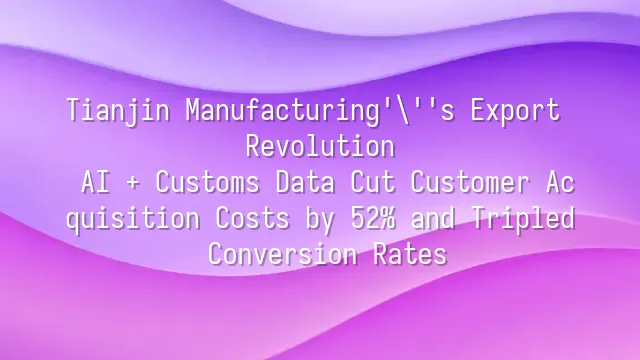
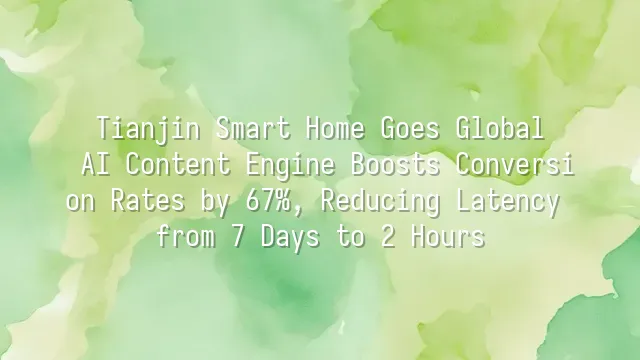
AI-driven precise acquisition solution for cross-border e-commerce, showcasing the work environment with Google Flow and Nano Banana model integration

Exploring how 2025's跨境电商 uses AI to optimize customer targeting, lower advertising spend, enhance conversion rates, and drive profitable growth with advanced technologies like the integration of Google Flow and Nano Banana model for marketing breakthroughs.

In a futuristic office, a cross-border e-commerce manager uses the MuleRun 2.0 platform for personalized email marketing, with a wool felt panda wearing a wide-brimmed hat on the background wall.

In the increasingly competitive landscape of cross-border commerce, targeting the right audience presents new challenges and opportunities. This article explores how AI-driven customer engagement strategies via email marketing can significantly enhance conversion rates while providing real-world examples through tools like MuleRun 2.0.

Cross-border e-commerce employee using Ali Qwen APP for email automation marketing

This article explores AI-powered customer acquisition in 2025 and explains how advanced e-commerce firms optimize their outreach via AI-enabled email tools. By embracing platforms like Alibaba's WanWen App and similar solutions, businesses can realize greater engagement rates at scale while lowering cost-per-acquisition significantly.

A young entrepreneur analyzing AI-driven keyword optimization strategies for a cross-border e-commerce site, with a bustling city and Microsoft logo in the background.

With the rapid development of AI technology and increasing maturity of the cross-border e-commerce market, new challenges and opportunities have emerged for the independent station acquisition landscape. This text will explore how AI drives this change by enhancing search engine rankings, personalized content creation, user value prediction, and targeted marketing campaigns, including examples and future strategic perspectives influenced by Microsoft’s comprehensive digital transformation.

Data scientists in an office using AI customer prediction models to optimize personalized email marketing strategies

With the rise of AI technologies, businesses are leveraging AI customer prediction models to transform their email marketing strategies. By analyzing customer behavior data in depth, these models make possible ultra-personalized, segmented campaigns, improving engagement rates for better outcomes.

AI-Driven Customer Acquisition New Era: A Comprehensive Analysis from Technology to Practice

This article analyzes how advancements in AI transform business customer acquisition strategies by focusing on trends and AI-based practices that clean client data and maximize lead conversion for跨境电商businesses across global audiences.

High-tech office building and smart advertising equipment in a futuristic city

With AI technologies rapidly evolving, leveraging AI to boost customer acquisition has become a key strategy for businesses looking to surpass growth limitations. Industries like standalone websites and cross-border e-commerce increasingly rely on AI for optimizing ad placements that not only reach potential clients efficiently but also decrease acquisition costs drastically (CPA). This report delves into strategies driving AI-driven ad optimization by major firms like Microsoft while exploring how these tactics enhance market competitiveness in the era of high accuracy customer targeting.

Corporate analysts using AI client prediction model for data analysis and precise customer screening

Leverage advancements in artificial intelligence to improve marketing effectiveness. This article discusses how to apply AI client prediction models to select the right audience for reduced inefficiency and increased revenue, analyzing everything from data gathering and algorithm application to practical implementation strategies.

Data scientists in a modern office using AI customer prediction models for data analysis to optimize customer acquisition efficiency.

In increasingly competitive markets, companies seek more cost-effective and efficient means to acquire customers. By applying AI-powered predictive models, businesses are capable of accurately targeting ideal customers and maximizing the value derived from their marketing investments.

In a futuristic city, a data analyst uses AI customer prediction models and hyper-personalized email marketing to achieve precise customer acquisition, with Microsoft's building symbolizing leadership in AI technology.

In the wave of digital transformation, AI-driven predictive models are crucial for identifying quality customers with precision. This article delves into leveraging such tools alongside hyper-personalization strategies, inspired by Microsoft's ambitious plans, to rethink digital strategy execution.

Data scientists monitoring the operation of an AI customer prediction model in a modern office

The ongoing development of artificial intelligence presents new ways for businesses to utilize models such as AI customer prediction to better filter and approach their potential customers more accurately and at lower cost. This brief explores how these models work and how latest technological advances, like those from Dexmal's Force Spirit platform, are revolutionizing customer interaction.